
Virtual Home Battery: The Future of Energy Storage
1. Description of the Challenge
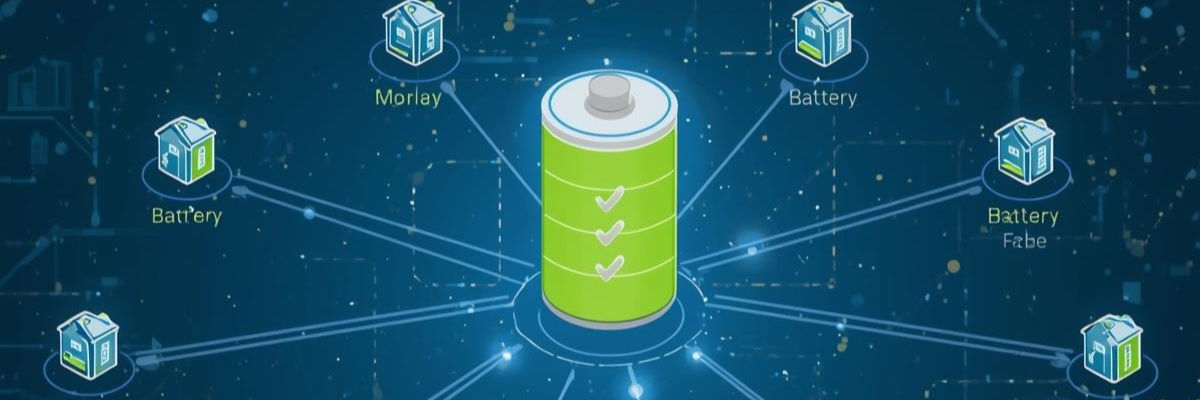
For large battery storage systems, the focus so far has been on deploying them in traditional electricity markets, such as the day-ahead market, the intra-day market, and for providing ancillary services (such as frequency response). However, a new business model is emerging: the virtual distribution of battery capacity among consumers, allowing this battery capacity to be rented as a virtual home battery.
The virtual home battery can enable so-called prosumers to rent their own energy storagecapacity without needing to physically install a battery in their home. This could help them store excess energy (for example, generated by solar panels) for later use or to trade on a peer-to-peer (P2P) energy market.
Consider the following aspects in your research
1. Technology and Infrastructure
- How can such a virtual distribution of battery capacity be technically realized? What infrastructure is needed to remotely manage and distribute the battery among different consumers?
- How is the interaction between the battery and the P2P energy market technically facilitated? What roles need to be fulfilled?
- What is the impact of a virtual home battery on national and local grid congestion?
2. Economic Feasibility
- What are the costs and benefits of renting out battery capacity to consumers instead of marketing the battery on traditional electricity markets?
- What could the pricing structure look like for consumers renting virtual storage capacity? How does this compare to the cost of purchasing a physical home battery?
- How can consumers benefit from P2P energy markets by using virtual batteries?
3. Regulation and Market Dynamics
- What regulations need to be considered for offering virtual home batteries and P2P energy trading? Are there barriers or limitations that need to be addressed?
- How would the virtual home battery fit within the proposed Energy Act?
- How could this model impact current electricity markets and the role of energy suppliers? Are there potential conflicts or synergies?
2. Expected Outcome
Based on your findings, formulate an advisory report for RWE: Should RWE explore this new model of virtual home batteries, and if so, under what conditions and with what strategy?
About RWE
RWE is leading the way to a modern energy world. With its investment and growth strategy, RWE is contributing significantly to the success of the energy transition and the decarbonisation of the energy system. Around 20,000 employees work for the company in over 20 countries worldwide.
RWE is one of the leading companies in the field of renewable energy. RWE is investing billions of euros in expanding its generation portfolio, in particular in off shore and onshore wind, solar energy and batteries. It is perfectly complemented by its global energy trading business. Thanks to its integrated portfolio of renewables, battery storage and flexible generation, as well as its broad project pipeline of possible new builds, RWE is well positioned to address the growing global demand for electricity, particularly driven by further electrification and artificial intelligence. RWE is decarbonising its business in line with the 1.5-degree reduction pathway and will phase out coal by 2030.
RWE will be net zero by 2040. Fully in line with the company’s purpose - Our energy for a sustainable life.